Paris for fiber artists, part 4: Science

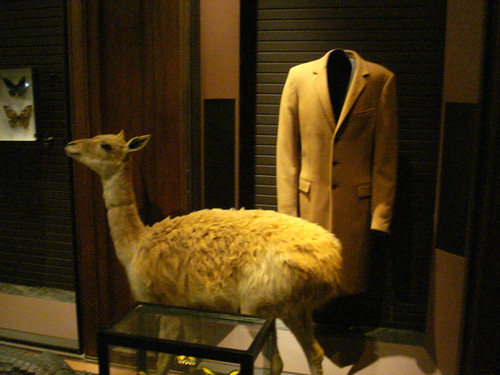
The last Parisian attraction I'll talk about is the Grande Gallerie d'Evolution in the Jardin des Plantes. This is a really fabulous museum, but I wasn't going in here expecting to see fiber stuff! So, it was a doubly pleasant surprise. The Grand Gallery of Evolution is a wonderful, large museum, mostly containing taxidermy animal specimens. All the signs are in French, so some of it was pretty mysterious, but it was still fascinating. Unique here was the room of endangered & extinct animals, containing many rare specimens, some among only a handful left in the world. But, I digress - the fiber, yeah?

Vicuna fleece vicugna vigogne guanaco camelid woven wool jacket natural history museum paris

Paris for fiber artists, part 3: History

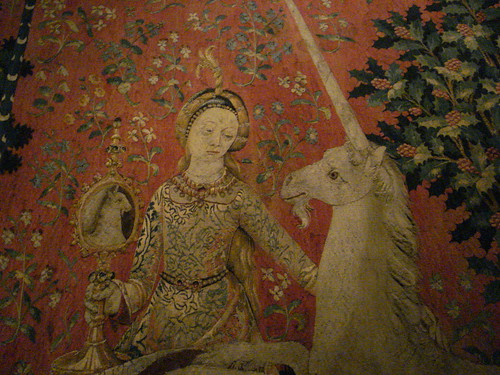
In this next part of my series on fibery and crafty things in Paris, I'll tell you a little about the Musee de Moyen Age, better known as the Musee Cluny. I didn't visit here specifically for the textiles, but there sure were plenty! They have so many beautiful tapestries.

The Musee de Cluny has a very large collection of medieval artifacts, including plenty of textiles. They currently have a room on Egyptian Coptic textiles, which was quite interesting. But what they're most famous for are the Lady & Unicorn tapestries.

Dame a la licorne unicorn einhorn tapestry woven handspun wool

Cooperative Press Kickstarter Campaign

There are just a few days left in Cooperative Press' Kickstarter fundraising campaign - they've already met their initial goal, but the more money they can raise, the more indie knitting design projects they can put out!

Cooperative Press Co-operative indie knitting publishing kickstart Knitgirl guide to professional knitting design

I've already kicked in my bit, and I strongly encourage you to do so too. Besides the warm fuzzy feeling, they're also giving out some really special thank you gifts - you can donate a little or a lot. Donating $10 or more gives you a copy of the The Knitgrrl Guide to Professional Knitwear Design, or donating $175 gets you a pair of handknit socks ;) The prizes are all across the board (I'm really excited for the knitwear design guide, and there are also some pattern offers up for non-designers) so there's lots to choose from.

Do take advantage of this - not only are you supporting publishing opportunities for indie designers (more publishing opportunities = more cool patterns to knit), but you can also snag some nice rewards.

~Joyuna

Paris for fiber artists, part 2: Art

Paris is world-famous for its art museums, most notably the Louvre. Lewis & I visited tons of museums during our trip to Paris, including the big three art museums the Louvre, the Musee D'Orsay, and the Musee de L'Orangerie.

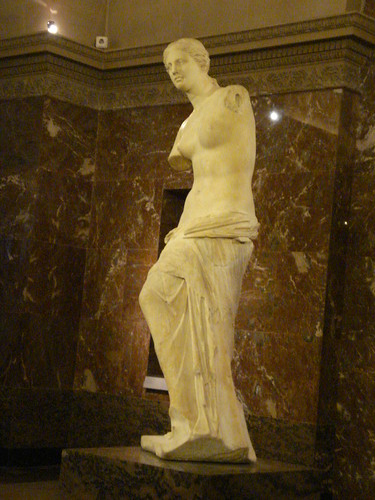
Venus de Milo Museum dorsay spindle spinning armless apple marble status Paris France

At the Louvre is one of the most famous pieces of Greco-Roman sculpture, the Venus de Milo. This statue of Venus (Aphrodite) is so famous as to be cliche, but did you know she might have been spinning? Spinning the thread of life? Spinning does have its place in Greek & Roman mythology, after all - for instance, the three moirae or three fates, who spin, measure, and cut each person's life. Spinning was tremendously important of course, so it's no wonder it shows up in myths - before machine in mills spun thread, even before foot-powered wheels, you couldn't make clothes without yarn to weave (or knit).

The theory is expounded upon in Venus de Milo, the Spinner by Elmer Suhr, which is on my potential reading list for sure.

Paris for fiber artists, part 1: Shopping

I'm back from my holiday in Paris, and it was an incredible time. I went with my boyfriend and we did all the major tourist things, the monuments, the museums, and whatnot.

Since I only had four days, and I was with a decidedly non-fibery man (despite his having made me two scarves in the past), I didn't get to do too much crafty stuff. For one thing, I didn't visit any Paris yarn shops. There were several that I considered visiting, including La Droguerie, which has its own line of yarn and patterns, and L'OisiveThe, a tea room which also sells hand-dyed yarn imported from the States. But the truth was there simply wasn't enough time for them, and most of the yarn in Paris was stuff I could buy either locally here in the UK, or online. Maybe next time I'll do a Paris yarn crawl, who knows.

However, I did do some shopping while in gay Paree, and one of my quests was for Japanese knitting books. I found two Japanese bookshops in Paris: BookOff, which specializes in used books, CDs, and DVDs, and Junku. Both are fairly close to each other - BookOff is just a few streets off the Place de Opera, and Junku is on the Rue des Pyramides.

Spinning socks on the fly

Spinners: Are you impatient, or possessing a short attention span? Do you tire of long stretches of spinning, eager to see how your yarn will knit up? Do you have a small spindle or bobbin, which holds hardly any yarn?

If you answered yes to any of these questions, then this "socks on the fly" technique is worth a try.
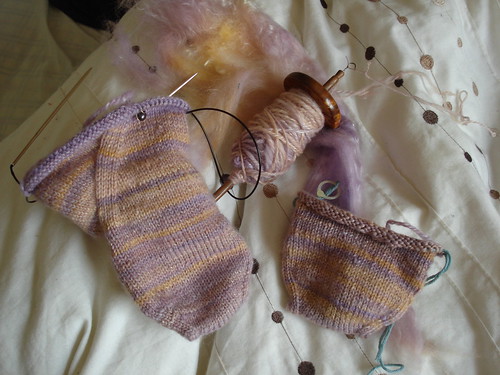
Socks on the fly navajo chain ply on the fly drop spindle two-at-a-time magic loop socks handspun technique

First, prepare your fiber. If you want your socks to match, split the braid in half lengthwise and predraft, or at least give the fiber a little fluff. Separate your fiber into pile A and pile B.

Begin spinning from pile A, using the Navajo ply on the fly technique. This is a fantastic method, and I wouldn't navajo ply any other way! Once your spindle is full, you will have a cop full of 3-ply chain-plied yarn. Wind it off the spindle into a ball, and begin knitting Sock A.

Sock A is on the needles, now start spinning from fiber pile B, chain ply on the fly, wind off, cast on Sock B. Lather, rinse, repeat until you have a new pair of handspun socks.

I started doing this because I am an impatient spinner, who takes ages to spin enough yarn for a pair of socks, always wants to see how my yarn knits up, and my spindle is tiny. When I was spinning for my Gail, I had to wind off the spindle 4 times, for only 2 ounces of fiber! So, if I was spinning it all first and then knitting it, I would have to keep joining the skeins anyway.

I'm loving this project. I get to knit and spin at the same time, I get both socks at the same time, and my stripes match (mostly). You could even adapt this method to knitting the socks 2AAT magic loop, but I don't like 2AAT, so I just put each sock on hold when it comes time to knit on the other sock. If you have two sets of needles, it's even easier.

~Joyuna

Turmeric dye update - Don't say I didn't warn you...

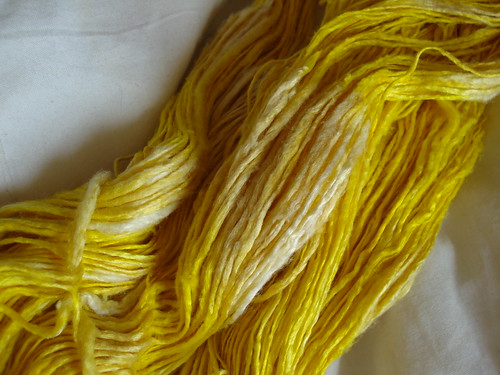
I've been spinning my turmeric-dyed silk hankies, and it's been going really well. The yellow is so sunny and vibrant, even if it does still smell a little of Asian cooking.

Indian turmeric dyed mawata silk hankies handspun spindle

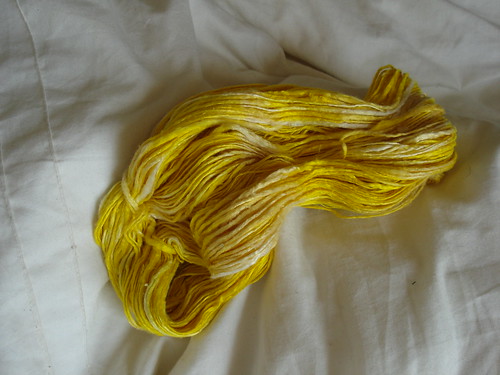
I did mention, briefly, in my last post, that turmeric is not a very colorfast dye. In particular, it's not lightfast - something I learned firsthand after foolishly leaving my skein of yarn by the window for about a week...
Will turmeric fade is turmeric dye light fast dyeing silk yarn with turmeric spice

A splotch of my yarn has faded from striking bright yellow to a dingy pastel. Lucky for me, this will just add to the hand-dyed look in my knitted object - BUT, if that's not the look you're after, keep your turmeric-dyed items out of the sun, or use a different method of dyeing.
~Joyuna

Paris!

I won't be around to post or answer emails for the next few days, because I will be in Paris! The boy and I are hopping the train for a little Easter break holiday (I'm a grad student and he's a teaching assistant, so our schedules are nicely lined up!).

Won't be doing anything very yarny there (I don't think there are many good yarn shops in Paris), except maybe knitting on the Eurostar :P See you guys on the weekend!

~Joyuna

Natural fiber sampler

I'm working on a long-haul spinning project. My toilet paper roll bobbins are already piling up. It all started when I kept getting these small samples of natural-colored fiber, as extras along with spindle orders. Some of the samples were extremely small, much too small to use on their own.

So far, I've got 6 different naturally colored fibers in my collection - Corriedale, Tunis, and Shetland wool, Suri alpaca, camel down and Egyptian cotton. I'm going to keep collecting until I have enough for a small shawl. They're all spun on my ultra-light .2oz spindle into fine laceweight singles.

Handspinning drop spindle fine lace weight yarns cotton camel wool alpaca

Once I gather up the courage to handle them, I'll ply them against themselves, skein them up and wash them. Then, when I have enough different fibers, I'll knit them in stripes.

I think this will be a really interesting study of the different qualities of types of fiber and sheep breeds. Knitted up, it will be like a multi-fiber swatch. I've already written some notes about how the different breeds behave. I hope to collect many more sheep breeds before the project is through.

~Joyuna

Featured at Louise Knits

Louise at Louise Knits wanted to post a feature about me on her blog, and it's now up! Check it out here. She's also got several patterns on her blog worth checking out.

Russell Square knitwear set design pdf patterns

Thanks a bunch Louise!

~Joyuna

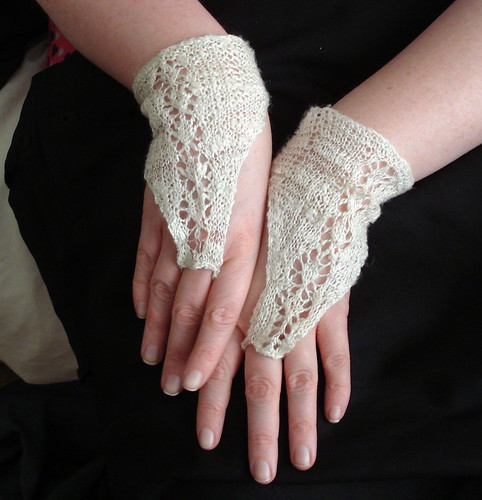
Mawata Pulsewarmers - Free pattern

If you enjoy the look and feel of handspun yarn, but haven't learned to spin, knitting with mawata (silk hankies) is the perfect option. Silk hankies are a lightly processed form of silk - each layer of 'hankie' is a single silkworm cocoon which has been stretched out over a frame. Since each coccoon is made up of one continuous strand of silk, these hankies can be stretched out into strands and still retain enough strength to be knit with.

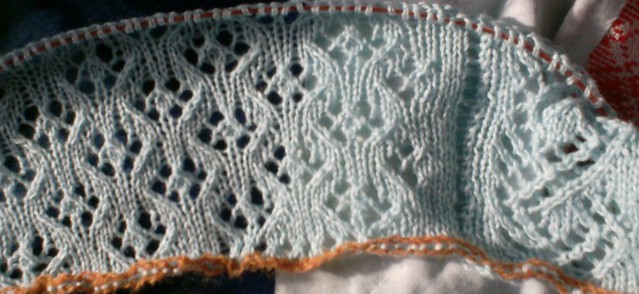
Free pattern fingerless cuff gloves mitts silk lace fingering weight

In order to knit with the silk mawata, take a single layer from your hankie stack - a single layer is very thin, and you should be able to see through it. Stick your finger through the middle of the sheet, creating a hole, then stretch it out with your hands. You can spread your arms apart to break it up initially, and then go over it inch by inch to make it thinner and more even.
For a step-by-step photo tutorial, check out this Knitty article.
If you hear ripping sounds as you attenuate your hankies, don't worry! - Remember, you're stretching out one single, very long strand of silkworm fiber. You have to rip the strand in some places in order for those fibers to slip past one another and create a thinner yarn. You will still be able to knit with it.
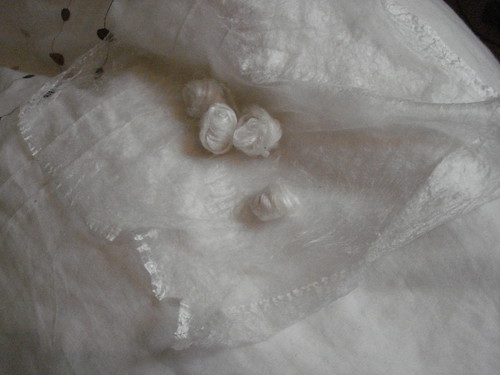
Mawata handspun silk hankies silk caps natural fiber for knitting

You can buy silk hankies from online markets such at Etsy, or places which sell fiber for spinning or felting. To get you started with knitting with mawata, here is a small, delicate project - a pair of these pulsewarmers will take less than 10g of hankies. Use them undyed for a classic, delicate look, or experiment with dyed hankies for a funky pair of colorful wristwarmers.

Working with Intwined Pattern Studio

Since I'm a big-time designer now (ha, ha, ha), I've sprung for some design software. A little while back, I purchased Intwined Pattern Studio. Intwined is a relative newcomer to the knitting software scene, but it's also at a much lower pricepoint than its biggest competitor, Knit Visualizer.

Nearly every piece of software on my computer came with it or was downloaded (legally) for free, so it takes something special for me to pay for software. And was I satisfied with it? Yeah, pretty much.
Intwined PS knitting pattern stuio visualiser charting software for cables and lace
Intwined has a huge library of stitches, and you can create your own as well. You can either work with Intwined's stitch elements (say, to create a unique cable symbol) or you can import your own stitch image. You can also change the existing stitch images, if you like your purls as dots instead of lines, or you have your own decrease symbols you prefer.

What fiber should I use for lace?

One of my top search engine terms, month after month, has been along the lines of 'what is the fiber content of lace', 'lace fiber content', 'fiber content of silk'... I'm not sure exactly why I'm getting so many hits on these terms, but I thought I'd write a little about it so if people find my blog, they'll find what they're looking for. :)

What fiber for lace knitting needle size

First of all, knitted lace is a very wide field. The definition of knitted lace is knitting that has holes in it. Some people consider knitting that has holes in only every other row (ie, every right side row) to not be 'true' lace, but considering the vast majority of lace patterns have plain wrong side rows, we will simply work with the definition of lace knitting as knitting with holes in.

Kyuubey in crochet amigurumi (with instructions)

Would you like to make a contract?

Mahou Shoujo Madoka Magica QB Kyubey stuffed plush toy crochet patter

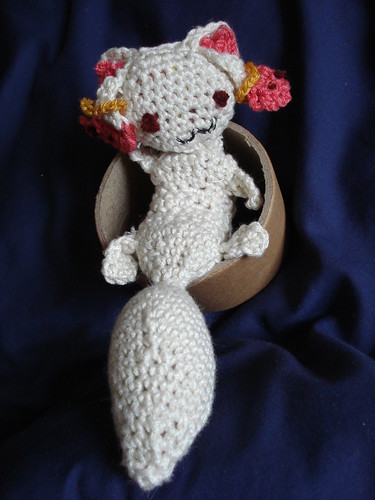
It's Kyuubey, everyone's favorite cuddly satanic messenger!

If you don't know who Kyuubey is, he's from the brilliant anime Puella Magi Madoka Magica, currently on hiatus due to the tsunami. Even if you haven't seen much anime, this show is absolutely worth a watch. If you grew up on Sailor Moon, Cardcaptors, or other magical girl series, watch this one and your mind will be blown. Cute little pigtailed magical girls, with fluffy mystical animal companion, and elements of Faust, secret codes, suicide cults...
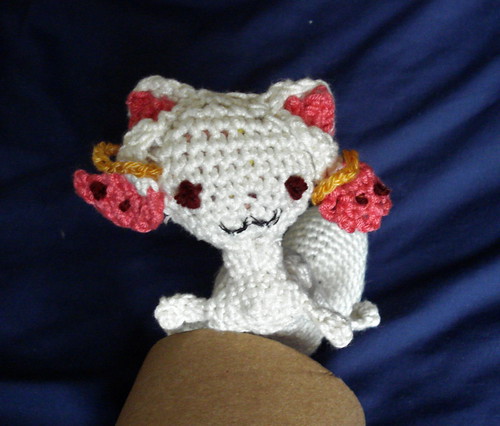
Faust Mephistopheles Madoka Mephisto Cubey toy crocheted Kyubeh with tutorial(more photos on Ravelry)

I'm a total crochet novice - I can't read crochet patterns, much less write them, but it's not hard to make your own Kyuubey. If you're familiar with the basic amigurumi techniques (single crochet, increase, decrease, slip stitch) you can make this. You stuff it as you go along; there's no sewing up involved.

You will need: A crochet hook, a yarn needle, stuffing, and yarn in four colors: white, pink, red, and gold (very small amounts of the last two), and some black yarn or thread for the mouth.
You can work this in any gauge, so long as the hook matches the thickness of the yarn so that the stuffing doesn't come through.

Read on for the how-to!

Ravelry? That's where I'm a viking!

Have you all seen the Ravelry forums for April Fool's today?

Ravelry April Fool's Day Joke Prank hats on ravatars avatars


Everyone has hats! I like mine :]

~Joyuna